English to Spanish Translator
- 4.3
- Rating
- 50.00K
- Installs
- Free
- Price
 Analysis by App-foxy
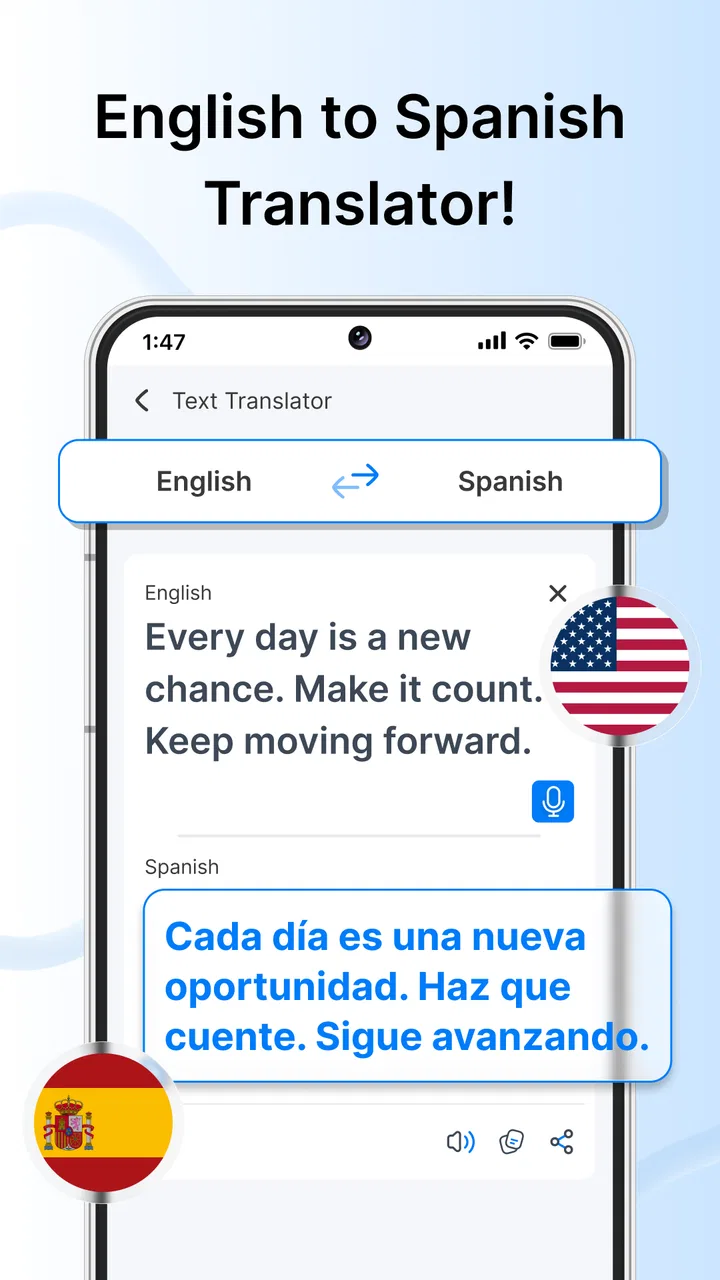
When I need to move between Spanish and English quickly, I usually want something simpler than opening a full language course. That is where English to Spanish Translator makes sense: it is an education app from Let's Roll Apps built around translating in both directions while I am on the move. I see it as a practical tool for short phrases, quick checks, travel moments, and everyday messages rather than a complete replacement for studying grammar.
The important decision is not whether a translator can produce a result. Most modern translation tools can do that. The better question is whether this particular app fits the way you work. I would judge it by the speed of the exchange, how much context I need to preserve, whether I want a focused interface, and how often I expect to use it. For someone who only needs occasional English-to-Spanish help, the free entry point is appealing. For serious learning, though, a translator should be treated as a support tool, not as the whole learning plan.
What I looked at before recommending it
Before I recommend a translator, I look past the first successful phrase and consider what happens when the wording is ambiguous, the message matters, or I need to use it repeatedly. I also weigh the app’s focused English–Spanish role against broader tools, because the best choice depends on whether convenience or deeper language support matters more to you. That helps set up the practical question: where does it genuinely save effort in an ordinary day?
You May Also Like

 Blood Strike: 2.5 Anniversary
Blood Strike’s Loadouts Turn Every Drop Into a Tactical Gamble
A close look at Blood Strike’s custom loadouts: how fast access to signature weapons reshapes its battle royale rhythm, rewards preparation, and narrows the gap between fights.

 Pandora - Music & Podcasts
Pandora’s Music Is Easy to Start, but Harder to Recover
Pandora’s strength is its low-effort path from a seed to a station. Its weak spot is how much confidence it asks you to place in connection, setup, and quiet recovery.

 8 Ball Pool
 Is Built on Rivalries, Rematches, and Routine
A close look at the rivalries, rematches, shared routines, and unanswered safety questions that turn a quick pool match into a persistent mobile community.

 Samsung Music
’s Quiet Strength Is Playing What You Already Own
Its reach comes less from spectacle than from dependable access to a personal library. That simplicity is both the app’s strongest retention engine and its ceiling.

 AccuWeather: Weather Radar
AccuWeather Review: A Quick, Clear Forecast for Everyday Decisions
For everyday plans, the best forecast is the one you can understand quickly. AccuWeather makes rain timing, radar, and local conditions easy to act on, with a few trade-offs.

 Hill Climb Racing
Why Hill Climb Racing Still Turns Crashes Into One More Run
A tiny car, a bumpy hill and one more upgrade: Hill Climb Racing keeps resurfacing because its simple chaos makes every near-miss feel personal.
More From Our News Desk
View All News


The app is best understood as a quick language utility
In my experience, the strongest reason to choose this app is its narrow purpose. It is not trying to be a broad classroom with lessons, streaks, quizzes, or a long study path. Its store summary centers on translating Spanish to English and English to Spanish while you are away from home or between tasks. That focus can be valuable because it keeps the decision uncomplicated: open it when a phrase needs to cross the language barrier, then return to whatever you were doing.
I would especially consider it for travelers, families communicating across English and Spanish, students checking their own wording, and anyone who occasionally receives a message in the other language. A focused translator can be less distracting than a large language-learning platform. It also avoids the common mistake of expecting a course app to solve an immediate translation problem.
Context matters more than a single correct-looking sentence
My main test for any translation app is not whether a short noun translates cleanly. That is easy. I pay more attention to phrases with an implied subject, polite requests, informal wording, and words that change meaning depending on the situation. English and Spanish do not always line up word for word, so I would never copy an important sentence without reading it back and asking whether it sounds natural for the person receiving it.
This leads to a useful workflow. I first write the full thought instead of entering isolated words. Then I compare the result with the original meaning, especially around names, dates, quantities, and instructions. If the sentence is important, I translate it back in the opposite direction as a rough sense check. That extra step is one of the most practical ways to reduce embarrassing mistakes, and it does not require any advanced knowledge of either language.
Who will get the most value from it?
I think the app is a good fit for people who need repeated small translations rather than a formal curriculum. Imagine receiving a message from a Spanish-speaking host while traveling. You can use the app to understand the immediate question, draft a reply, and check whether your wording communicates the right request. The same pattern works for a parent helping with homework, a shopper reading a notice, or a colleague preparing a simple bilingual message.
It can also help a beginner notice patterns. After translating several similar phrases, I can compare how verbs, articles, or polite expressions change. That is not a substitute for explanations from a teacher, but it turns real situations into small learning opportunities. I find this more useful than memorizing disconnected vocabulary because the words are attached to a purpose.
Who should choose something else?
I would not make this my only tool if I were preparing for an exam, studying advanced writing, or trying to build a structured daily habit. A dedicated language course is better when I need pronunciation practice, grammar explanations, graded exercises, and progress tracking. A dictionary is often better when I need several meanings, example sentences, regional usage, or a careful explanation of one word.
I would also look elsewhere for professional documents, legal wording, medical communication, or anything where a small misunderstanding could have serious consequences. A general translator can help me create a starting draft, but important material deserves a qualified human review. The convenience of a quick result should not be confused with guaranteed precision in specialized situations.
Where this translator wins in everyday use
I find the clearest everyday advantage in having one place to handle both sides of a short exchange, especially when I need to understand a message before replying. A small habit makes that more useful: keep the original sentence simple, check names and times separately, and treat the translation as a draft when tone matters. With that workflow in mind, the next question is whether the app stays worthwhile after the first few convenient uses.
A low-friction choice for short exchanges
The app’s biggest practical advantage is that its purpose is immediately clear. I do not need to decide whether I should open a lesson, search a course, or navigate a large collection of study material. When my need is “What does this mean?” or “How do I say this?”, a dedicated translation screen is the natural place to begin.
That simplicity matters when I am standing in a shop, moving through a station, or trying to reply to somebody who is waiting. In those moments, a complicated learning platform can feel like unnecessary work. A focused translator lets me spend my attention on the conversation rather than on the tool.
A useful two-pass method for better results
One non-obvious strength of a bilingual translator is that I can use it as both a translator and a checking loop. For example, I might draft an English message, translate it into Spanish, and then translate that Spanish result back into English. If the meaning changes noticeably, I know I should simplify the original sentence before sending it.
I find this especially useful when writing instructions. Rather than using idioms such as “get the ball rolling” or “I’ll touch base,” I can choose direct language, run it through the app, and inspect the result. The trick is not asking the tool to rescue complicated wording. The better habit is to give it clear wording that already expresses one idea at a time.
It encourages phrase-level thinking
Beginners often enter one word and assume the answer is complete. I would use this app differently. A phrase such as “I am looking for the office” carries more information than the word “office” alone, and the surrounding words help identify the intended meaning. When I enter a complete sentence, I give the translator enough material to make a more useful choice.
This also helps me identify places where a literal translation may sound unnatural. If I am learning, I can keep a small note of phrases that repeatedly appear in my real conversations. That turns a quick translation session into a personal phrasebook without pretending that the app is a full course.
The value of a free starting point
The app is free to install, which makes it easy for me to test it against my own routine before committing to a different solution. It has an average rating of 4.3 from around 60 ratings, and it has passed 50 thousand installs, so there is at least a visible audience using it for this kind of task. I would still treat those figures as context rather than proof that every translation will suit every user.
The developer is Let's Roll Apps, and the app is marked for Teen users. It was released in late June 2025 and is currently on version 1.23, with Android support starting at version 6.0. Those details make it accessible to people using older compatible Android devices, while the relatively recent release means I would pay attention to how comfortably it fits my particular phone before making it my only translation option.
Where the experience may feel limited
A focused tool can also feel narrow. If I want to understand why a translation uses a particular tense, compare regional alternatives, or practice speaking, a basic translation workflow may leave me wanting more. The result may be useful without teaching me enough to produce the next sentence independently.
I also need to keep the limitations of automated translation in mind. Short, direct sentences are safer than jokes, slang, poetic writing, or sentences with several possible meanings. Names and place references deserve a second look. Even when the output appears fluent, I would check that the tone is right: a friendly message, a workplace request, and a formal note should not all sound identical.
How I would use it during a real day
Suppose I am visiting a Spanish-speaking city and need to ask whether a bus stops near a particular museum. I would first write a complete, simple English question. After viewing the Spanish version, I would remove anything unnecessary and keep the core request. If the driver answers in Spanish, I can use the reverse direction to understand the reply, then confirm the key detail by looking for the place name and time.
That scenario shows both the app’s strength and its boundary. It can reduce friction in a practical exchange, but I still need to listen, observe signs, and confirm details. Translation is one part of communication. It does not remove the need for patience, gestures, or a second check when the information matters.
How it compares with the usual alternatives
The closest alternative is a general-purpose translation service. That type of tool may be preferable if I already rely on it for many languages, other formats, or a wider set of language utilities. Its advantage is breadth. The focused advantage here is that I can approach the English-Spanish task without sorting through unrelated features.
A dictionary is the better choice when I am studying a particular word deeply. It can show meanings, usage, and distinctions that a quick sentence translation may not explain. A language-learning app wins when I need a planned path and regular practice. A human tutor wins when I need feedback on intent, tone, pronunciation, and cultural nuance.
So I would not describe this translator as universally better than those options. I would choose it when the job is immediate bilingual assistance. I would choose the dictionary, course, or tutor when the job is understanding language at a deeper level.
Thinking about paid features before switching habits
Although the app is free, it includes in-app purchases ranging from about eleven dollars to about fifty-five dollars per item. That makes the cost decision worth considering before I build my daily routine around it. I would first use the free experience for the specific situations I actually face, then decide whether any paid option solves a recurring problem for me.
The cost of switching is not only financial. It also includes saved routines, familiarity, and the time spent learning another interface. If a general translator already handles my conversations well, moving to a separate app may not be worthwhile. On the other hand, if I want a smaller English-Spanish-focused tool and find myself opening it frequently, staying with one consistent workflow can be more efficient than jumping between several services.
I would be cautious about paying simply because I hope a paid tier will turn translation into language mastery. No purchase can replace deliberate practice. The sensible test is whether the app saves enough time or reduces enough friction in my own use to justify the expense. If I only translate a phrase once every few weeks, the free option may be all I need.
Small habits that make the results more dependable
I would keep sentences short, but not so short that the meaning disappears. “Book” could refer to an object or an action, while “I want to book a room for tonight” gives the translator a clear situation. I would also avoid combining several requests in one long paragraph when accuracy matters.
Before sending a translated message, I would check names, numbers, times, and negative words such as “not” or “never.” These details can be more important than whether the sentence sounds elegant. For a conversation, I would prepare a few essential phrases in advance rather than waiting until I am under pressure.
Finally, I would use the app as a bridge, not a mask for uncertainty. If I do not understand the translated reply, I would ask for a simpler sentence or confirm the key point. That approach is more reliable than assuming a polished-looking output has captured every nuance.
My recommendation for different kinds of users
For a traveler or occasional bilingual communicator, I recommend giving English to Spanish Translator a try. The free starting point, focused purpose, and two-way use make it a sensible first step for everyday phrases. It is also suitable for a learner who wants to inspect real messages and build a personal collection of useful expressions.
For a student seeking a complete learning system, I would use it alongside a course rather than instead of one. For professional or high-stakes communication, I would use it only to prepare a draft and ask a fluent person to review the final wording. For someone who already has a trusted all-purpose translator and rarely needs English-Spanish exchanges, switching may offer too little benefit.
My final view is positive but practical: this is a convenient education app for quick English-Spanish translation, not a complete language solution. Its value comes from reducing the delay between having a question and getting a usable starting answer. If I keep my sentences clear, check important details, and understand when human judgment is needed, it can earn a place in my everyday toolkit. The best reason to install it is convenience; the best reason to keep another learning resource nearby is context.
FAQs for English to Spanish Translator
01What is English to Spanish Translator used for?
English to Spanish Translator is designed to help users translate words, phrases, and complete sentences between English and Spanish. It can be useful for travel, school, work, casual conversations, and understanding unfamiliar content. After testing it, the app feels most convenient for quick translations rather than replacing a professional human translator for legal, medical, or highly specialized documents.
02Does English to Spanish Translator work without an internet connection?
Offline availability depends on the version of the app and whether Spanish language data can be downloaded in advance. Basic translation features may require an active internet connection, especially for longer sentences, voice input, or pronunciation tools. Before traveling or relying on it in areas with poor coverage, users should check the app’s settings and confirm which language features are available offline.
03Does the app support voice translation and pronunciation?
Many English-to-Spanish translator apps include voice input, text-to-speech, or pronunciation playback, making them helpful during conversations and language practice. The experience can vary depending on the device, microphone quality, selected language settings, and internet access. Users should speak clearly and review the translated text, since accents, background noise, slang, and regional expressions may sometimes produce inaccurate results.
04Is English to Spanish Translator accurate for every type of text?
The app generally performs well with common vocabulary, short phrases, and straightforward sentences. However, translations may be less reliable with idioms, humor, cultural references, technical terminology, or sentences that depend heavily on context. Spanish also differs across regions, so wording used in Spain may not always sound natural in Mexico, Argentina, Colombia, or other Spanish-speaking countries.
05Is English to Spanish Translator free and safe to download?
The app may be available as a free download, although some versions can include advertisements, optional purchases, or premium features such as unlimited voice translation and offline language packs. Users should download it from the official Google Play Store or Apple App Store, review requested permissions, and read the privacy information. Avoid unofficial APK files, particularly when the app handles microphone or copied text.
Pros
- Translates common words and phrases quickly for everyday conversations.
- Useful offline mode for basic translations when internet access is unavailable.
- Voice input makes it easier to translate while traveling or multitasking.
- Includes pronunciation support to help users speak Spanish more confidently.
- Simple interface makes the app accessible for beginners and casual users.
Cons
- Accuracy may drop with slang
- regional expressions
- or complex sentences.
- Some features may require an internet connection or paid access.
- Voice recognition can struggle with background noise or strong accents.
- Automatic translations may miss cultural context and intended tone.
- Frequent ads can interrupt use
- especially in the free version.

English to Spanish Translator
Gallery